The Bluenose Chronicles

A Blog About Yesterday's Nova Scotia

  • Robbery, Arson at Sheet Harbour Post Office Leads to Thrilling Police Pursuit

    The following article appeared in the Halifax Evening Mail on Saturday July 30, 1898. It tells the exciting tale of one Alexander Fraser, a 23-year-old tramp miner, who robbed and then set fire to the post office in Sheet Harbour.
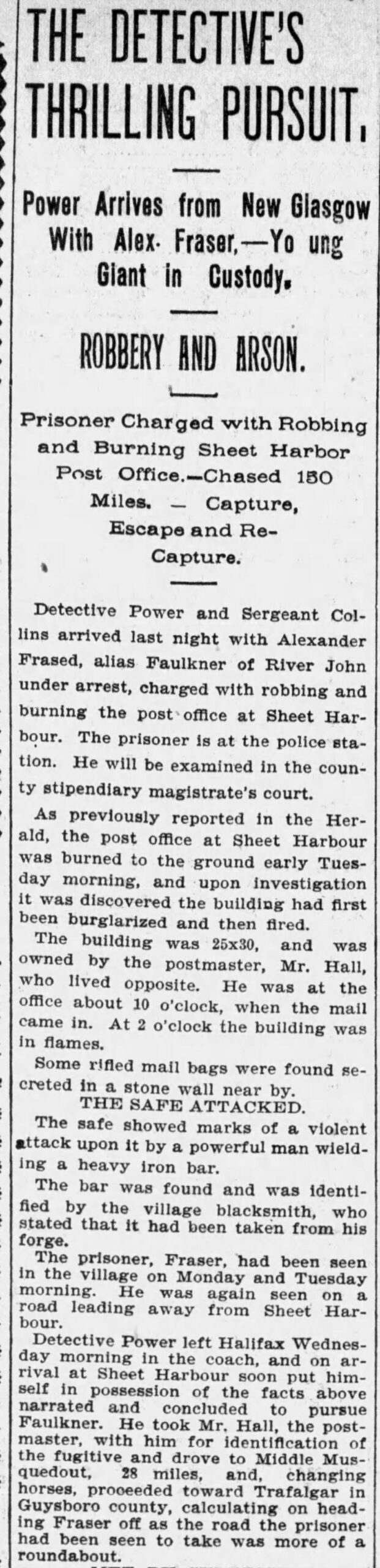
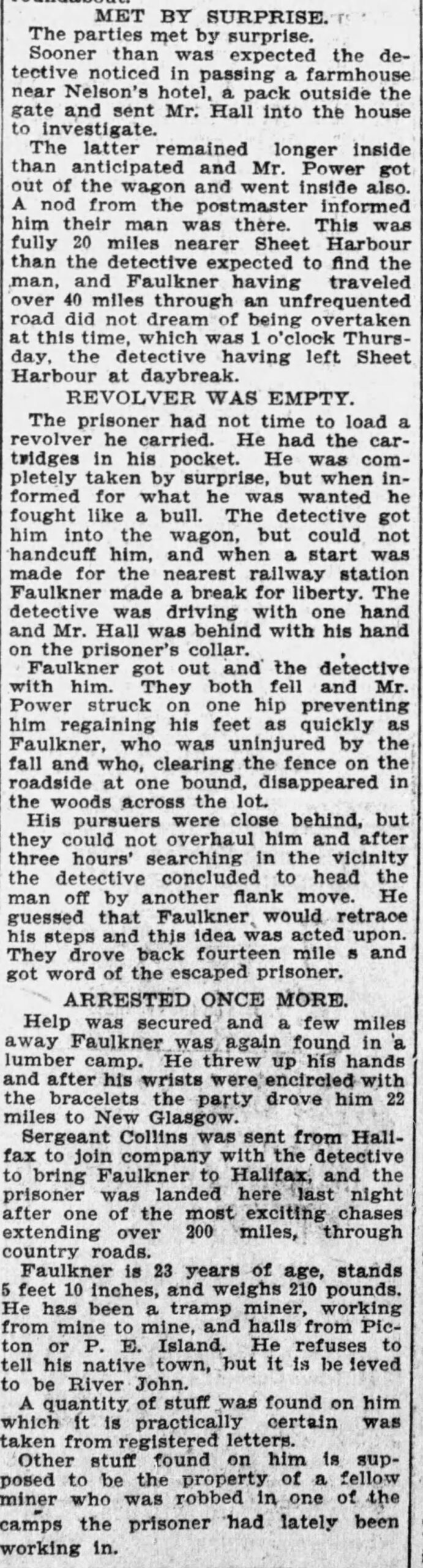
    Article in the Evening Mail about the police pursuit of Alexander Fraser, who robbed and burned the Sheet Harbour post office in 1898.
    Article in the Evening Mail about the police pursuit of Alexander Fraser, who robbed and burned the Sheet Harbour post office in 1898.

    A Detective Power from Halifax led the pursuit of the wanted fugitive. Power took the postmaster, Mr. Hall, with him to help identify the criminal. Fraser, who also went by the alias Faulkner, was caught at a farmhouse in Guysborough County some 40 miles from Sheet Harbour.

    However, Faulkner – clearly not wanting to face the consequences of his actions – managed to escape while in custody. Detective Power sought help from locals, and they managed to find the escapee at a nearby lumber camp. Once again secured, they drove him to New Glascow to wait for backup in the name of Sergeant Collins to arrive from Halifax.

    Power and Collins arrived in Halifax with their feisty fugitive “after one of the most exciting chases extending over 200 miles through country roads,” according to the news report.


    Sources:
    Halifax Evening Mail, 30 July 1898
  • The World Anxiously Awaits Rescue at Moose River Gold Mine

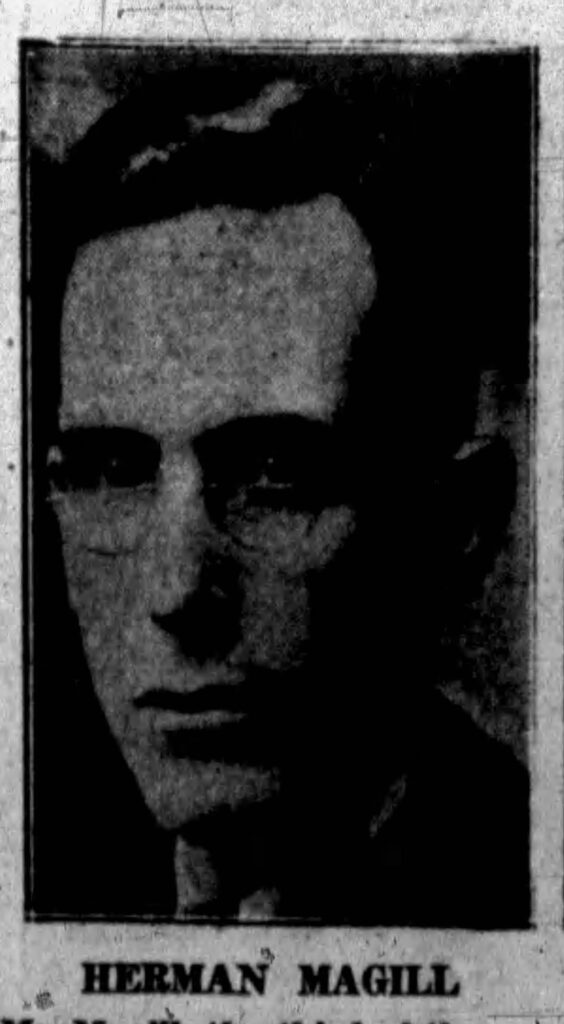
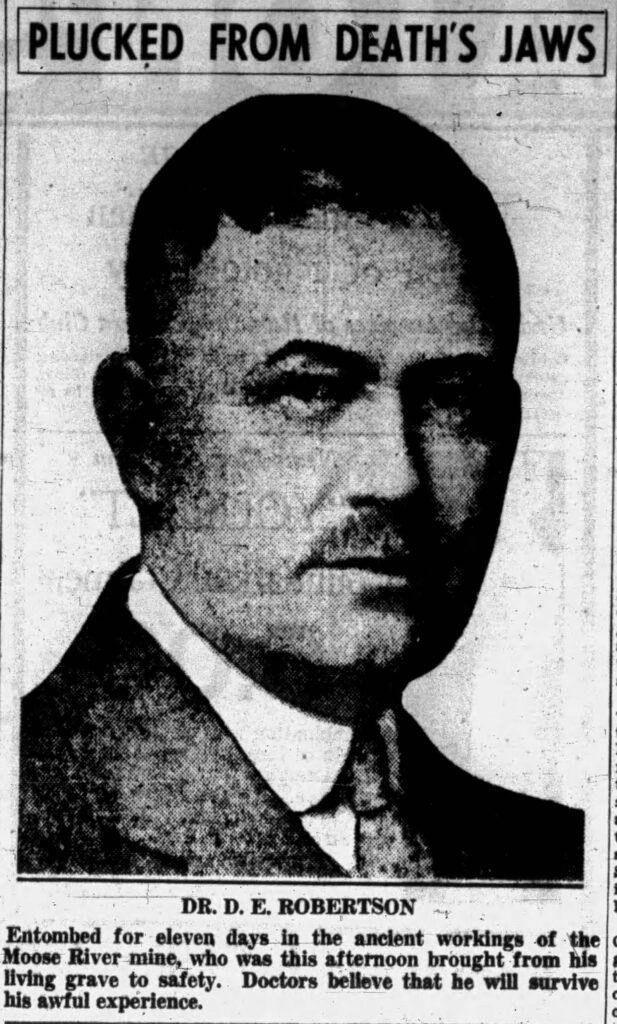
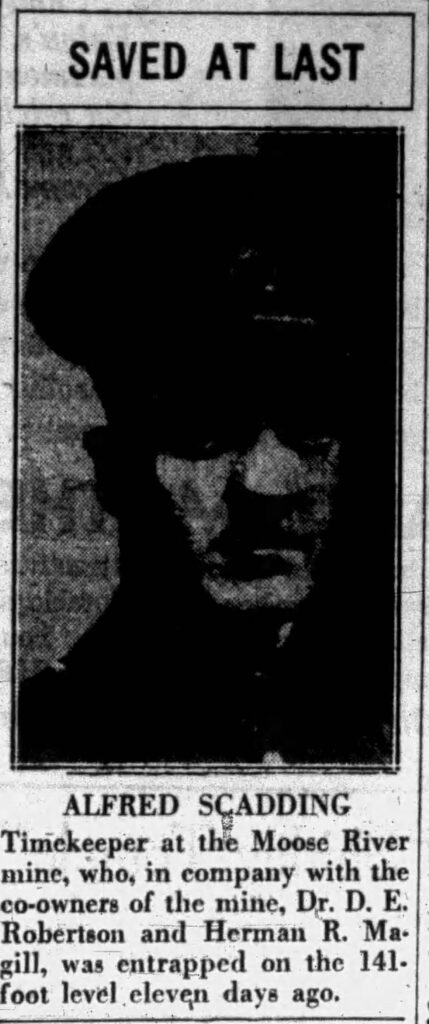
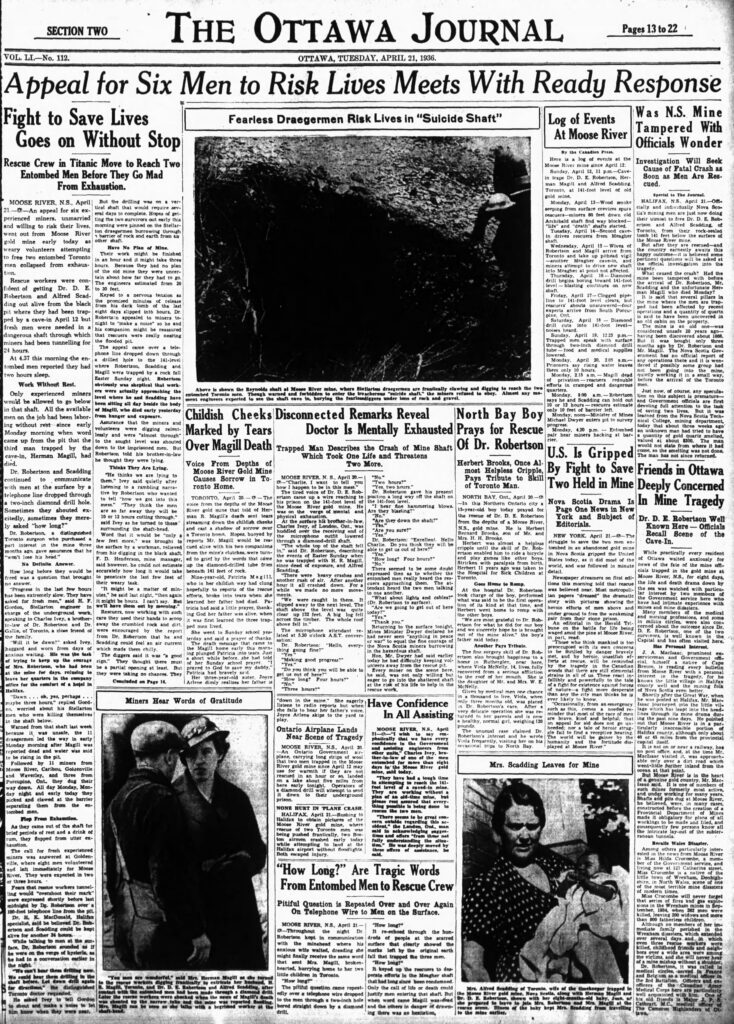
    On April 12, 1936, three men – Herman Magill, David Robertson, and Alfred Scadding – became trapped in the Moose River gold mine when it caved in during an inspection. What followed was a tale of daring heroism, tragic loss, and anxious anticipation.

    Coverage of the Moose River gold mine disaster in the Ottawa Journal (21 April 1936).
    Coverage of the Moose River gold mine disaster in the Ottawa Journal (21 April 1936).

    Trapped 150 feet below ground, these three men became the subject of a daunting rescue operation in a race against time. The entombed men were reached by a borehole on the sixth day. They were given food and water (and a telephone wire). Unfortunately Herman Magill died the following day.

    The disaster captured the minds of not just Nova Scotians and Canadians but of people around the world. The world was in the grip of the Great Depression, and people were captivated by a story of hope. In addition to international newspaper coverage, around the clock radio broadcasts were done by J. Frank Willis of the Canadian Radio Broadcasting Commission (the forerunner of the CBC). It was the first 24-hour news story to be covered in Canadian media.

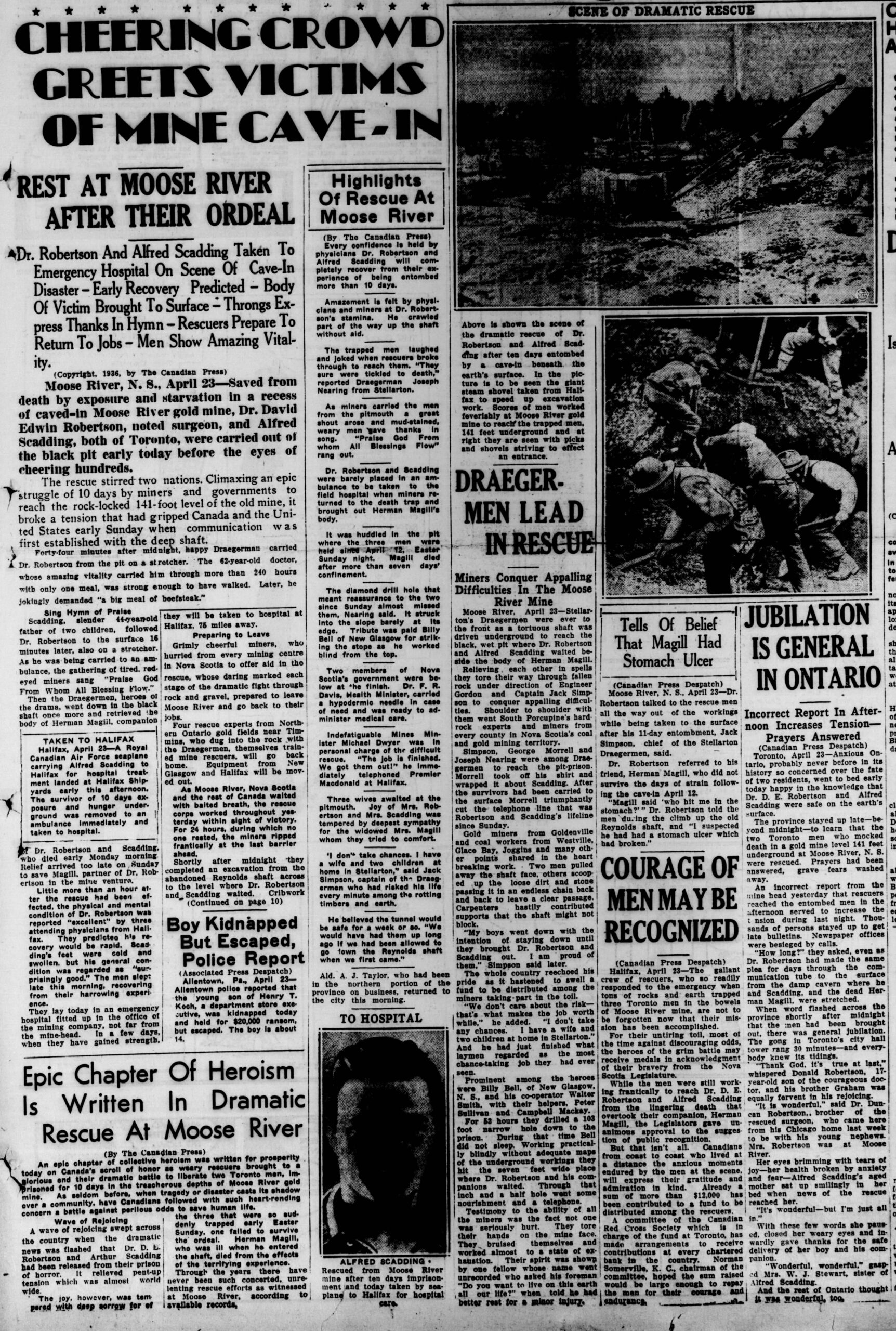
    Canadian Press coverage of the Moose River gold mine disaster in Moncton Transcript (23 April 1936).

    After 11 days, the rescue was finally complete. Crowds at Moose River cheered as the two surviving men were brought up. While the celebration was muted due to the loss of Magill, people around the world still were able to marvel in a mostly happy ending.

    You can listen to J. Frank Willis’ reporting of the Moose River disaster on CBC Archives: https://www.cbc.ca/player/play/audio/1.3626289


    Sources:
    Hamilton Spectator, 22 April 1996
    Moncton Transcript, 23 April 1936
    Ottawa Journal, 21 April 1936
    https://view902.com/draegerman-courage-a-nova-scotia-tale/

  • An Advertisement for Jeddore Hard Grit Sand

    Evening Mail, 13 May 1916.

    The above advertisement appeared in the Evening Mail on May 13, 1916. As per the ad, Proprietors Captain William Power of East Jeddore and Captain S.A. Maskell of West Jeddore are offering up what is clearly superior sand for use in building houses. So, if you want your house to keep standing and be free of cracks it looks like your best your choice is Jeddore Hard Grit Sand.

    O’Connor’s was a clothing company located at 417 Barrington Street in Halifax.

    Captain William Power was my third great uncle.

  • Welcome

    Welcome to the Bluenose Chronicles. First off, this is not a blog about the Bluenose sailing ship or its replica the Bluenose II. Although perhaps there will be an article or two about those. Instead, this is a blog about yesterday’s Nova Scotia. A place to share memories, stories, and photos of the people and places of urban and rural Nova Scotia throughout the years.

    The term “bluenose” or “bluenoser” has been used to describe Nova Scotians for centuries. So I thought it would make a perfect name for this blog. My mom was a “bluenoser” and I know she would approve.

    Why am I doing this? Genealogy is one of my favourite hobbies and for years I have researched my mother’s family history. Her family has roots along the Eastern Shore of the province. Often, I come across interesting information that is not really connected to my family from a genealogical perspective. But the stories and photos are still important and worthy of sharing.

    When starting a new project like this, you don’t really know where it will take you. Will people even read it? But I believe this blog has at least some merit. And I hope you will enjoy reading it as much as I enjoy writing it.

    I don’t know the frequency of how often I will publish blog posts. So be sure to check back every now and then. Also, I think it’s important to note that I don’t use AI to generate content. I write everything myself. So that means you may come across errors, typos, and spelling/grammar mistakes. That’s fine. History (and the present) isn’t perfect; neither is this blog.

    So, without further ado, let’s get this thing started.